

Juniper Core Data Center

Thông tin học phí & các ưu đãi
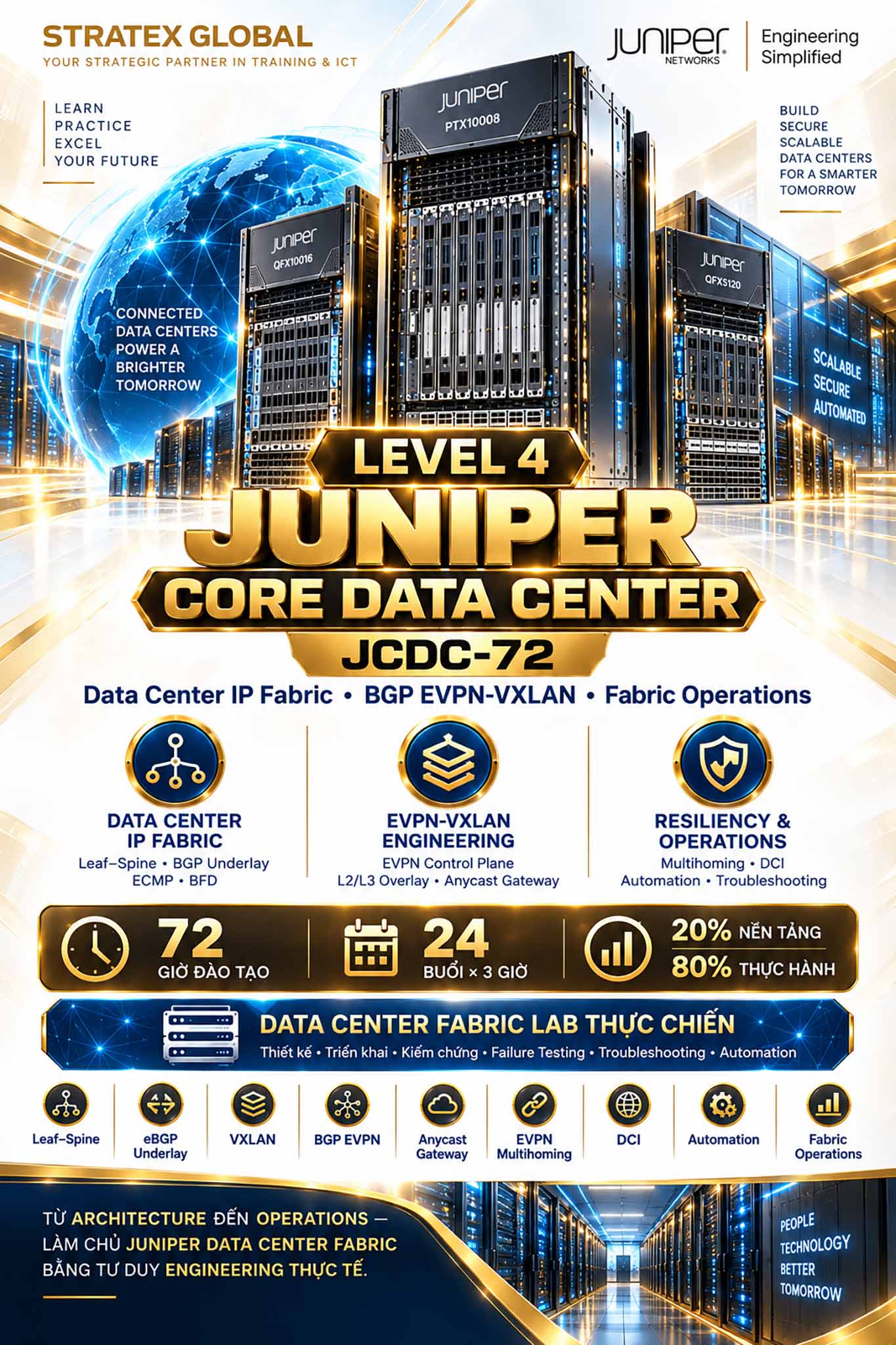
Juniper Core Data Center là chương trình Level 4 – Advanced Core Data Center Engineering trong lộ trình Juniper Network Engineering, tập trung phát triển năng lực thiết kế, triển khai, kiểm chứng, vận hành và xử lý sự cố Data Center IP Fabric hiện đại. Chương trình nhấn mạnh tư duy kiến trúc, Engineering và khả năng phân tích Control Plane/Data Plane.
Kế thừa nền tảng từ Level 3, học viên từng bước xây dựng Leaf–Spine IP Fabric, BGP Underlay, VXLAN, BGP EVPN, L2/L3 Services, Anycast Gateway, EVPN Multihoming và DCI, qua đó hiểu cách Underlay, Overlay, Services, Resiliency và Operations phối hợp trong một kiến trúc Core Data Center hoàn chỉnh. Toàn bộ chương trình được triển khai trên một Juniper Data Center Fabric xuyên suốt, kết hợp Validation, Forwarding Path Analysis, Failure Testing và Troubleshooting.
Kết thúc chương trình, học viên có khả năng thiết kế, xây dựng, kiểm chứng, vận hành và bàn giao một Juniper Data Center Fabric hoàn chỉnh theo tư duy Advanced Core Data Center Engineering.
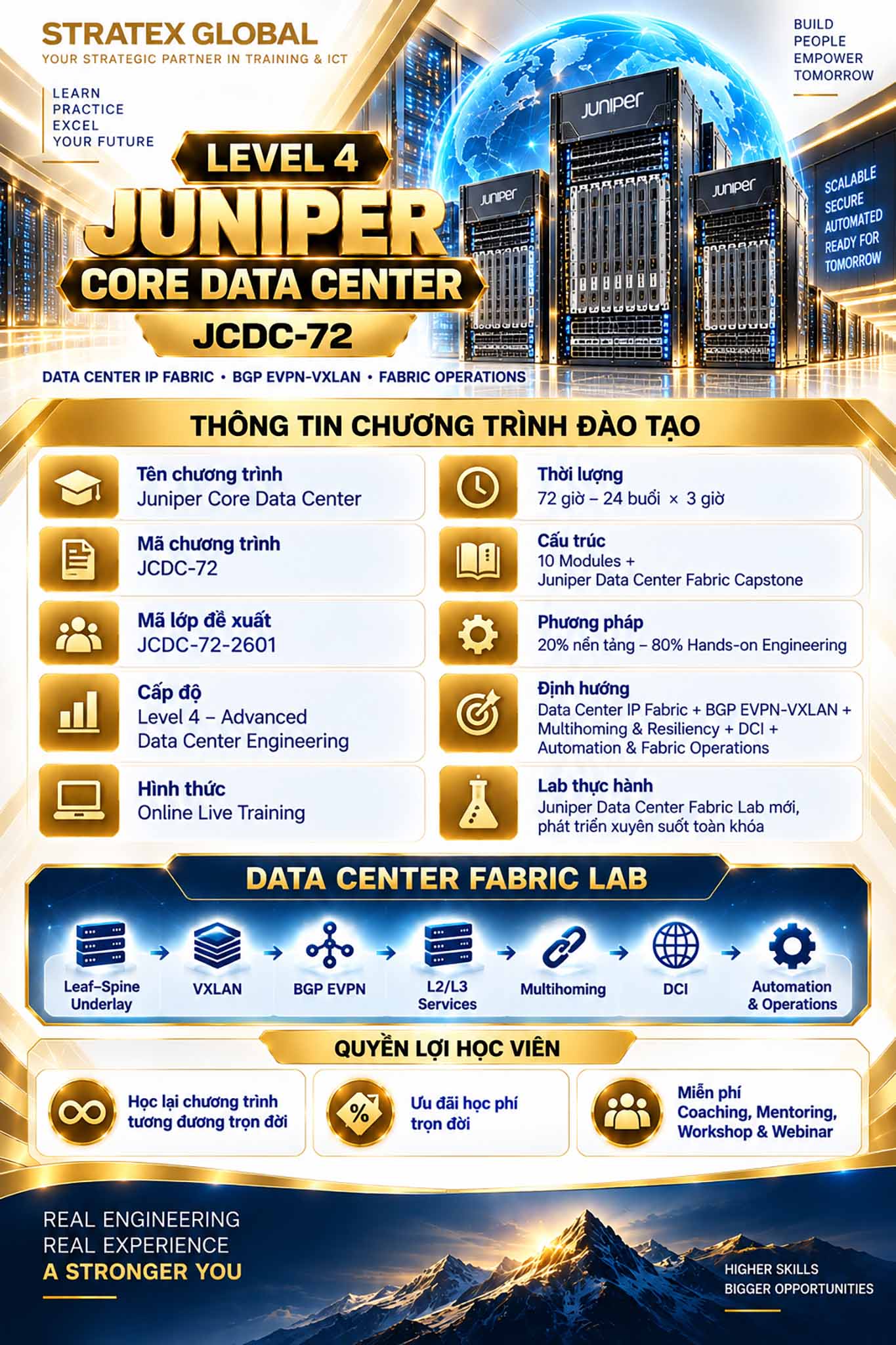
THÔNG TIN CHƯƠNG TRÌNH ĐÀO TẠO
- Tên chương trình: Juniper Core Data Center
- Mã chương trình: JCDC-72
- Mã lớp: JCDC-72-2601
- Cấp độ: Level 4 – Advanced Core Data Center Engineering
- Hình thức: Online Live Training
- Thời lượng: 72 giờ – 24 buổi × 3 giờ
- Cấu trúc: 10 Modules + Juniper Data Center Fabric Capstone
- Phương pháp: 20% nền tảng – 80% Hands-on Engineering
- Định hướng: Data Center IP Fabric + BGP EVPN-VXLAN + Multihoming & Resiliency + DCI + Automation & Fabric Operations
- Lab thực hành: Juniper Data Center Fabric Lab mới, phát triển xuyên suốt toàn khóa từ Leaf–Spine Underlay → VXLAN → BGP EVPN → L2/L3 Services → Multihoming → DCI → Automation & Operations
- Học lại chương trình tương đương trọn đời.
- Ưu đãi học phí trọn đời.
- Miễn phí Coaching, Mentoring, Workshop & Webinar.
Thời lượng
Tổng thời lượng: 72 giờ đào tạo chuyên sâu – 24 buổi × 3 giờ
JCDC-72 được thiết kế theo định hướng Advanced Core Data Center Engineering, tập trung phát triển năng lực thiết kế, triển khai, kiểm chứng, vận hành và xử lý sự cố trên kiến trúc Juniper Data Center IP Fabric hiện đại. Chương trình gồm 10 Modules theo lộ trình liên tục từ Leaf–Spine Architecture, BGP Underlay, VXLAN, BGP EVPN đến L2/L3 Services, EVPN Multihoming, DCI, Automation và Fabric Operations, giúp học viên phát triển năng lực theo chiều sâu thay vì học từng công nghệ rời rạc.
- Cấu trúc chương trình: 10 Modules phát triển trên cùng một Data Center Fabric, kết thúc bằng Juniper Data Center Fabric Capstone tích hợp kiến thức, kỹ năng Engineering và Operational Validation.
- Môi trường đào tạo: Junos OS, Juniper QFX/vJunos-switch, EVE-NG cùng Juniper Data Center Fabric Lab phát triển xuyên suốt 24 buổi; sử dụng QFX vật lý khi cần kiểm chứng hành vi phụ thuộc phần cứng.
- Phương pháp đào tạo: 20% Technical Foundation – 80% Hands-on Engineering, kết hợp Design, Implementation, Validation, Packet Walk, Failure Testing, Fault Injection, Troubleshooting, Recovery và Documentation.
- Định hướng kiến thức: Data Center IP Fabric – BGP EVPN-VXLAN – L2/L3 Overlay Services – Multihoming & Resiliency – DCI – Automation & Fabric Operations.
- Định hướng Engineering: Analyze → Design → Build → Implement → Validate → Test Failure → Troubleshoot → Recover → Automate → Operate → Document.
- Mục tiêu đầu ra: Phát triển năng lực thiết kế, xây dựng, triển khai, kiểm chứng, tự động hóa, vận hành và xử lý sự cố trên một Juniper Data Center Fabric hoàn chỉnh, có khả năng mở rộng, dự phòng, hỗ trợ Multi-Tenant Services và kết nối Multi-Site.
Điểm cốt lõi của JCDC-72 là học viên trực tiếp xây dựng, mở rộng, kiểm chứng, chủ động tạo lỗi, xử lý sự cố và vận hành một Data Center Fabric xuyên suốt toàn khóa, từ Leaf–Spine ban đầu đến BGP EVPN-VXLAN Fabric hoàn chỉnh với Multihoming, DCI, Automation và Fabric Operations.
Nội dung đào tạo
This opening module transitions learners from Enterprise Networking to Data Center Engineering, establishing the architectural mindset and design principles required for modern Data Center fabrics. Learners explore Clos architecture, Leaf–Spine design, traffic patterns, failure domains, redundancy, and foundational planning before beginning fabric implementation.
Core Topics:
- Traditional Three-Tier vs. Leaf–Spine Architecture
- Clos Fabric Architecture
- East–West & North–South Traffic
- Scale-Out Design Principles
- Spine, Leaf, Border Leaf & Service Leaf Roles
- Failure Domains & Redundancy
- Oversubscription & Capacity Planning
- IP Addressing & Loopback Planning
- ASN Planning
- VLAN, VNI & VRF Planning
- HLD & LLD Fundamentals
- Fabric Source of Truth
Hands-on Engineering:
- Learners analyze Data Center requirements, design a reference Leaf–Spine topology, build the Device Inventory and Interface Matrix, develop the IP/ASN/Loopback Plan, and standardize the Fabric Source of Truth that will serve as the engineering baseline for the entire JCDC-72 program.
Checkpoint:
- Fabric Architecture, HLD/LLD, addressing plans, and Fabric Source of Truth are completed and validated.
This module establishes the operational foundation for Juniper Data Center Switching, focusing on QFX platform architecture, system state, forwarding components, interface operations, and device standardization. Learners build the baseline operational knowledge required to prepare Spine and Leaf nodes before deploying the Data Center Fabric.
Core Topics:
- Juniper QFX Architecture
- Control Plane & Forwarding Plane
- Packet Forwarding Engine
- Interface, FPC/PIC & Port Architecture
- Interface Speed, Optics & Breakout Concepts
- VLAN, IRB & LAG Operational State
- Chassis & System Health
- Alarm & Interface Diagnostics
- LLDP
- Management & System Services
- SSH, NTP & Syslog
- NETCONF
- Commit, Rollback & Configuration Backup
- Configuration Diff & Baseline Management
Hands-on Engineering:
- Learners standardize the Junos baseline configuration for Spine and Leaf nodes, configure Management Services, LLDP, Logging, NETCONF, validate chassis and interface health, and build a reusable Fabric Node Health Check process before beginning Data Center Fabric deployment.
Checkpoint:
- Spine and Leaf baseline configurations are standardized, validated, and confirmed to meet Fabric Node Health requirements.
This module establishes the physical and logical foundation of the Data Center Fabric using a 3-Stage Clos architecture, preparing the environment for routed underlay deployment, server connectivity, and future VXLAN services. Learners focus on Leaf–Spine connectivity, interface consistency, MTU planning, server attachment, and failure-domain design before introducing routing protocols into the Fabric.
Core Topics:
- 3-Stage Clos Architecture
- Leaf-to-Spine Full-Mesh Connectivity
- Layer 3 Fabric
- Routed Fabric Interfaces
- Point-to-Point Addressing
- Unnumbered Design Overview
- Interface & Cabling Consistency
- End-to-End MTU Planning
- VXLAN Encapsulation Overhead
- Server Single-Homing
- Server Dual-Homing
- LACP & Link Aggregation
- Data Center Failure Domains
- MC-LAG vs. EVPN Multihoming
Hands-on Engineering:
- Learners deploy routed Leaf–Spine connectivity, validate LLDP and interface mapping, standardize end-to-end MTU, configure server attachment, and verify LACP operation before introducing the routing protocol into the Fabric.
Checkpoint:
- Physical and logical Fabric connectivity, MTU consistency, interface mapping, and server attachment are validated and confirmed to meet deployment requirements.
This module builds a scalable IP Fabric Underlay using eBGP, ECMP, Routing Policy, and BFD to provide resilient VTEP reachability and fast convergence across the Leaf–Spine Fabric. Learners focus on underlay routing design, controlled route advertisement, multipath forwarding, failure detection, and operational validation.
Core Topics:
- IP Fabric Underlay Architecture
- eBGP Underlay Design
- ASN Design Models
- BGP Peering
- VTEP Loopback Advertisement
- Routing Policy
- Prefix Filtering
- Route Leak Prevention
- BGP Next-Hop & Route Resolution
- Equal-Cost Multi-Path – ECMP
- BGP Multipath
- BFD Integration
- Fast Failure Detection
- Fast Convergence
- Underlay Acceptance Criteria
- Underlay Troubleshooting Workflow
Hands-on Engineering:
- Learners deploy eBGP across the Leaf–Spine Fabric, advertise VTEP loopbacks with controlled policy, enable ECMP and BFD, perform link and Spine failure testing, and validate underlay convergence and reachability under failure conditions.
Checkpoint:
- eBGP Underlay, ECMP, BFD, VTEP reachability, and convergence behavior are validated and confirmed to meet underlay acceptance criteria.
This module extends the Fabric from the Layer 3 Underlay into the VXLAN Data Plane, enabling learners to understand how overlay traffic is encapsulated, transported, and forwarded across the Data Center Fabric. The focus is on VTEP behavior, VNI mapping, packet forwarding, encapsulation overhead, and MTU validation.
Core Topics:
- VLAN Scalability Limitations
- VXLAN Architecture
- VXLAN Header
- UDP Encapsulation
- Virtual Tunnel Endpoint – VTEP
- Virtual Network Identifier – VNI
- VLAN-to-VNI Mapping
- Underlay vs. Overlay
- Remote VTEP Reachability
- BUM Traffic
- MAC Learning
- VXLAN Packet Walk
- Encapsulation Overhead
- MTU Troubleshooting
Hands-on Engineering:
- Learners build the first VXLAN segment, validate VTEP and VNI operation, capture traffic across the Fabric, analyze inner and outer headers, and troubleshoot issues related to MTU, VTEP reachability, and overlay forwarding.
Checkpoint:
- VXLAN Data Plane operation, VTEP reachability, VNI mapping, encapsulation behavior, and MTU consistency are validated and confirmed to operate correctly.
This module is one of the core technical pillars of JCDC-72, introducing BGP EVPN as the control plane for the VXLAN Fabric. Learners move MAC/IP learning from the data plane into a scalable control-plane model, gaining deep understanding of EVPN route types, MP-BGP signaling, RD/RT policy, tenant isolation, and operational verification.
Core Topics:
- BGP EVPN Architecture
- EVPN Address Family
- MP-BGP EVPN Signaling
- Underlay vs. Overlay BGP
- Overlay Peering
- Route Reflector Architecture
- EVPN Route Type 1
- EVPN Route Type 2
- EVPN Route Type 3
- EVPN Route Type 4
- EVPN Route Type 5
- MAC/IP Advertisement
- Inclusive Multicast Ethernet Tag
- Route Distinguisher – RD
- Route Target – RT
- Import/Export Control
- Tenant Isolation
- Control-Plane MAC Learning
- MAC Mobility
- EVPN Policy
- EVPN Database & Operational Verification
- EVPN Troubleshooting
Hands-on Engineering:
- Learners deploy the EVPN Overlay, build the Route Reflector architecture, migrate VXLAN from manually defined remote VTEPs to EVPN-based signaling, analyze EVPN route types, validate MAC/IP advertisements, RD/RT import-export behavior, and tenant isolation, and troubleshoot control-plane issues across the Fabric.
Checkpoint:
- EVPN peering, route-type propagation, RD/RT policy, MAC/IP learning, tenant isolation, and control-plane operation are validated and confirmed to meet Fabric design requirements.
This module evolves the EVPN-VXLAN Fabric into a service-delivery platform for Layer 2 and Layer 3 tenant services, while introducing distributed gateway functionality at the Fabric edge. Learners focus on IRB, tenant VRFs, L2/L3 VNIs, Distributed Anycast Gateway, Symmetric IRB, Border Leaf design, and external connectivity.
Core Topics:
- Layer 2 Overlay Services
- Layer 2 VNI
- Controlled VLAN Stretching
- Integrated Routing and Bridging – IRB
- Tenant VRF
- Centrally Routed Bridging
- Edge-Routed Bridging
- Gateway Placement
- Distributed Anycast Gateway
- Layer 3 VNI
- Symmetric IRB
- Inter-Subnet Routing
- EVPN Type 2 Route
- EVPN Type 5 Route
- East–West Packet Flow
- North–South Packet Flow
- Border Leaf Architecture
- External Network Connectivity
- Tenant Route Policy
Hands-on Engineering:
- Learners build Layer 2 overlay services, deploy IRB, migrate gateway functionality from a centralized model to a Distributed Anycast Gateway, implement Layer 3 VNIs and Symmetric IRB, and extend tenant connectivity toward Enterprise/WAN networks through the Border Leaf.
Checkpoint:
- Layer 2/Layer 3 overlay services, Distributed Anycast Gateway, Layer 3 VNIs, Symmetric IRB, and Border Leaf connectivity are validated and confirmed to meet tenant service and Fabric design requirements.
This module develops active-active resiliency at the Fabric edge using EVPN Multihoming, while examining how the Fabric converges during server, access-link, Leaf, and broader Fabric failures. Learners focus on Ethernet Segments, ESI-LAG, DF election, aliasing, split-horizon, mass MAC withdrawal, and service recovery behavior.
Core Topics:
- Ethernet Segment
- Ethernet Segment Identifier – ESI
- ESI-LAG
- LACP Integration
- All-Active Multihoming
- EVPN Route Type 1
- EVPN Route Type 4
- Aliasing
- Designated Forwarder Election
- DF / Non-DF Behavior
- BUM Traffic Handling
- Split-Horizon
- Loop Prevention
- Mass MAC Withdrawal
- MAC Mobility
- EVPN Multihoming vs. MC-LAG
- Link Failure
- Leaf Failure
- Fabric Failure
- Convergence Measurement
Hands-on Engineering:
- Learners dual-home a Server/CE across two Leaf switches, deploy ESI-LAG, analyze EVPN Route Type 1/4 and DF election behavior, and perform fault injection across access links, Leaf nodes, and Fabric paths to measure route withdrawal, packet loss, convergence, and service recovery. Hardware-dependent behaviors are validated on Juniper QFX or through a dedicated Hardware Validation Lab when required.
Checkpoint:
- EVPN Multihoming, ESI-LAG, DF/Non-DF behavior, route withdrawal, convergence, and Fabric resiliency are validated and confirmed to meet failure-test criteria.
This module extends the Data Center Fabric from a single site into a Multi-Site architecture, while integrating automation, validation, monitoring, and operational assurance into the Fabric lifecycle. Learners focus on DCI design, service control, failure-domain isolation, automation workflows, configuration consistency, monitoring, compliance, and change management.
Core Topics:
- Data Center Interconnect Architecture
- Layer 2 Extension vs. Layer 3 Interconnect
- Border Leaf / Gateway
- EVPN-VXLAN DCI
- Multi-Site Architecture
- Failure-Domain Isolation
- Site-Specific RD/RT/VNI Planning
- DCI Route & Service Policy
- Prefix Filtering & Loop Prevention
- DCI MTU & Convergence
- Fabric Source of Truth
- Configuration Templates
- Jinja
- Junos PyEZ / Ansible
- Automated Backup
- Pre-Check & Post-Check
- Fabric Consistency Validation
- Syslog
- SNMP / Telemetry
- Fabric Health Monitoring
- Configuration Drift
- Compliance Checking
- Change Management
- Upgrade Planning
- Rollback Strategy
Hands-on Engineering:
- Learners interconnect two EVPN-VXLAN Fabrics/Sites at lab scale, control which tenants and services are permitted across the DCI, and automate backup, configuration generation, state collection, and validation. They also build a reusable Fabric Health & Compliance Report to support operational assurance, consistency checking, and day-to-day Fabric management.
Checkpoint:
- DCI policy, Multi-Site service control, automation workflows, Fabric validation, monitoring, and operational processes are validated and confirmed to operate according to design.
This capstone integrates the full JCDC-72 learning journey into a complete Juniper Data Center IP Fabric, bringing together architecture, implementation, automation, operations, validation, and advanced troubleshooting. Learners receive a set of technical requirements and must execute the complete Data Center Engineering lifecycle from design through final acceptance.
Core Topics:
- Requirements Analysis
- Leaf–Spine Architecture
- Failure Domain Design
- IP / ASN / Loopback Planning
- VLAN / VNI / VRF Design
- RD / RT Planning
- HLD & LLD Review
- Routed Leaf–Spine Fabric
- eBGP Underlay
- ECMP
- BFD
- VTEP Reachability
- VXLAN Data Plane
- BGP EVPN Control Plane
- Layer 2 Overlay
- Layer 3 Overlay
- Distributed Anycast Gateway
- Symmetric IRB
- EVPN Multihoming
- Border Leaf
- Data Center Interconnect
- Configuration Backup
- Automated Validation
- Fabric Health Check
- Configuration Compliance
- Change Validation
- Operational State Collection
- Multi-Layer Fault Injection
- Impact & Scope Analysis
- Failure Domain Identification
- Underlay vs. Overlay Failure Analysis
- Control Plane vs. Data Plane Failure Analysis
- Service vs. Endpoint Failure Analysis
- Root Cause Analysis
- Corrective Action
- Preventive Action
- Acceptance Testing
Hands-on Engineering:
- Learners design, build, validate, automate, and operate a complete Juniper Data Center Fabric based on defined technical requirements. During the capstone, the instructor performs Multi-Layer Fault Injection, requiring learners to isolate the failure domain, identify the root cause, restore service, and document corrective and preventive actions. After recovery, learners rerun the complete acceptance test and prove Fabric health using operational state, routing tables, EVPN databases, MAC tables, logs, counters, packet captures, and end-to-end traffic tests.
Checkpoint:
- The complete Juniper Data Center Fabric is designed, implemented, validated, recovered from injected faults, and confirmed to meet final architecture, service, resiliency, automation, operational, and acceptance criteria.
JUNIPER DATA CENTER FABRIC CAPSTONE DELIVERABLES
Khi hoàn thành JCDC-72, học viên phải xây dựng, hoàn thiện và bảo vệ một Data Center Engineering Package toàn diện, phản ánh đầy đủ vòng đời của một Juniper Data Center Fabric:Architecture & Design → Implementation → Validation → Resiliency Testing →Operations → Technical Handover
1. Tài liệu Kiến trúc & Thiết kế
- High-Level Design – HLD
- Low-Level Design – LLD
- As-Built Fabric Topology
- Fabric Source of Truth
- Device Inventory
- Interface & Cabling Matrix
- IP / ASN / Loopback Plan
- VLAN–VNI–VRF Matrix
- RD/RT & EVPN Service Matrix
- BGP Underlay Peering Matrix
- EVPN Overlay Peering Matrix
- Server Attachment & ESI Matrix
- DCI Service & Policy Matrix
2. Hồ sơ Triển khai Fabric
- Validated Fabric Configuration
- Configuration Backup
- Implementation Baseline
- Operational State Evidence
3. Kiểm chứng, Khả năng Dự phòng & Nghiệm thu
- Underlay Acceptance Test Report
- VXLAN/EVPN Validation Report
- Multihoming Failure Test Report
- DCI Failure Test Report
- Fabric Health Report
- Compliance Report
- End-to-End Service Validation Evidence
4. Vận hành & Xử lý sự cố
- Incident & Root Cause Analysis Report
- Operations Runbook
- Change Plan
- Rollback Plan
- Recovery Validation Evidence
5. Bàn giao Kỹ thuật Cuối cùng
- Final Technical Presentation
- Solution Defense
- Architecture & Design Justification
- Validation & Troubleshooting Evidence
- Final Fabric Handover Package
Điểm cốt lõi của Capstone là học viên phải chứng minh Fabric hoạt động đúng bằng bằng chứng kỹ thuật, thay vì chỉ thể hiện rằng cấu hình đã được hoàn tất. Mọi quyết định liên quan đến Underlay, Overlay, EVPN Services, Multihoming, DCI, Automation, Resiliency và Operations đều phải được thiết kế, triển khai, kiểm chứng, tài liệu hóa và bảo vệ về mặt kỹ thuật.
Kết quả cuối cùng không đơn thuần là một bài thực hành cuối khóa, mà là một Data Center Engineering Package có cấu trúc, có tiêu chí nghiệm thu và có đầy đủ bằng chứng kiểm chứng, có thể được sử dụng làm tài liệu tham chiếu cho triển khai, nghiệm thu, vận hành, xử lý sự cố, quản lý thay đổi và bàn giao kỹ thuật trong môi trường Data Center thực tế.
Phương pháp đào tạo
JCDC-72 được triển khai theo một chu trình Data Center Engineering xuyên suốt, phản ánh cách một kỹ sư Data Center chuyên nghiệp tiếp cận hệ thống từ phân tích yêu cầu đến triển khai, kiểm chứng, xử lý sự cố và bàn giao: Analyze → Design → Pre-Check → Implement → Validate → Failure Test → Troubleshoot → Recover → Document
Trong mỗi giai đoạn, học viên phải thực hiện đầy đủ quy trình Engineering:
- Phân tích Requirements, Constraints và Failure Domains
- Thiết kế giải pháp và xác định Acceptance Criteria trước khi triển khai
- Thực hiện Pre-Check, Backup và thiết lập Operational Baseline
- Triển khai cấu hình trên Junos theo Change Plan
- Xác minh Control Plane và Data Plane
- Phân tích Forwarding Path và Packet Walk
- Thực hiện End-to-End Service Validation
- Thực hiện Fault Injection và Failure Testing có kiểm soát
- Troubleshoot dựa trên Operational Evidence
- Thực hiện Rollback và Recovery khi cần thiết
- Cập nhật Fabric Source of Truth
- Hoàn thiện As-Built Documentation, Validation Records và Technical Evidence
Chương trình không đánh giá học viên chỉ dựa trên khả năng cấu hình đúng câu lệnh hay làm cho hệ thống hoạt động. Trọng tâm nằm ở năng lực hiểu kiến trúc, giải thích Forwarding Behavior, kiểm chứng trạng thái hệ thống, xác định Failure Domain, tìm Root Cause và bảo vệ quyết định kỹ thuật bằng bằng chứng.
Mỗi bài thực hành đều phải đáp ứng một nguyên tắc thống nhất: thiết kế phải có cơ sở, triển khai phải có kiểm soát, kết quả phải được kiểm chứng, sự cố phải có khả năng phục hồi và toàn bộ hệ thống phải có đủ bằng chứng kỹ thuật để nghiệm thu, vận hành và bàn giao.
JCDC-72 vì vậy được xây dựng theo hướng evidence-based engineering, trong đó mọi thay đổi trên Fabric đều phải có design rationale, validation criteria, operational evidence và rollback readiness.
Định hướng năng lực sau khi học
Sau khi hoàn thành Juniper Core Data Center – JCDC-72, học viên có khả năng thiết kế, triển khai, kiểm chứng, vận hành và bàn giao một Juniper Data Center Fabric hoàn chỉnh theo tư duy Advanced Core Data Center Engineering. Học viên có thể xây dựng kiến trúc Leaf–Spine, triển khai eBGP IP Fabric Underlay, ECMP, Routing Policy, BFD, phát triển VXLAN Data Plane, BGP EVPN Control Plane, Layer 2/Layer 3 Overlay Services, Distributed Anycast Gateway, Layer 3 VNI, Symmetric IRB, EVPN Multihoming và tích hợp Border Leaf, DCI cho môi trường Multi-Site.
Bên cạnh năng lực triển khai, học viên còn có khả năng thực hiện Failure Testing, Convergence Validation, Fault Injection, Root Cause Analysis, Rollback và Recovery, đồng thời tự động hóa các hoạt động Configuration, Backup, Pre/Post-Check, Validation, Fabric Health, Compliance và Operational Monitoring bằng các công cụ như Jinja, Junos PyEZ và Ansible. Toàn bộ quá trình được kiểm chứng bằng Operational Evidence, bao gồm trạng thái Control Plane/Data Plane, Routing Table, EVPN Database, MAC Table, Logs, Counters, Packet Capture và End-to-End Traffic Test.
Kết thúc chương trình, học viên không chỉ biết cấu hình EVPN-VXLAN mà có thể làm chủ toàn bộ vòng đời Analyze → Design → Implement → Validate → Failure Test → Troubleshoot → Recover → Operate → Document → Handover, đồng thời hoàn thiện HLD, LLD, As-Built Documentation, Fabric Source of Truth, Acceptance Reports, Operations Runbook, Change Plan và Rollback Plan để phục vụ triển khai, nghiệm thu, vận hành và bàn giao kỹ thuật trong môi trường Data Center thực tế.

Thông tin học phí & ưu đãi
Thông tin học phí và ưu đãi:
- Học phí niêm yết: 18.900.000 VNĐ
(Đã bao gồm VAT 8%) - Ưu đãi đăng ký sớm: 13.230.000 VNĐ
(Đã bao gồm VAT 8% – giảm 30%) - Ưu đãi dành cho sinh viên: 12.285.000 VNĐ
(Đã bao gồm VAT 8% – giảm 35%, áp dụng khi cung cấp giấy tờ chứng minh sinh viên hợp lệ) - Thời hạn ưu đãi: Đến hết ngày 30/09/2026
- Đào tạo doanh nghiệp: Học phí, hình thức tổ chức, nội dung tùy chỉnh và các điều kiện triển khai được thỏa thuận riêng theo nhu cầu, quy mô đội ngũ, kiến trúc hệ thống và yêu cầu đào tạo thực tế của doanh nghiệp.
Chương trình đào tạo Juniper Core Data Center

Juniper Core Data Center – JCDC-72 được xây dựng nhằm phát triển học viên từ nền tảng Enterprise Networking lên năng lực của một Advanced Core Data Center Engineer – có khả năng nhìn Data Center như một kiến trúc tổng thể và hiểu sâu mối quan hệ giữa Underlay, Overlay, EVPN Services, Resiliency, DCI, Automation và Operations.
Thông qua một Juniper Data Center Fabric xuyên suốt, học viên từng bước thiết kế và triển khai Leaf–Spine Architecture, eBGP IP Fabric, VXLAN, BGP EVPN, Layer 2/Layer 3 Overlay Services, Distributed Anycast Gateway, EVPN Multihoming, Border Leaf và Multi-Site DCI, kết hợp Validation, Failure Testing, Troubleshooting và Recovery để hiểu cả cách hệ thống vận hành lẫn cách phản ứng khi xảy ra sự cố.
Chương trình nhấn mạnh tư duy evidence-based engineering, trong đó mọi thiết kế, thay đổi và quyết định kỹ thuật đều phải được kiểm chứng bằng Operational Evidence và Acceptance Criteria. Mục tiêu cuối cùng của JCDC-72 là giúp học viên có khả năng thiết kế, xây dựng, kiểm chứng, tự động hóa, vận hành và bàn giao một Juniper Data Center Fabric hoàn chỉnh ở cấp độ Advanced Core Data Center Engineering.
Juniper Core Data Center – JCDC-72 được thiết kế theo định hướng Advanced Core Data Center Engineering, tập trung phát triển năng lực thiết kế, triển khai, kiểm chứng, vận hành và xử lý sự cố trên một Juniper Data Center Fabric hoàn chỉnh. Toàn bộ chương trình được xây dựng theo lộ trình kỹ thuật xuyên suốt từ Leaf–Spine Architecture, eBGP Underlay, VXLAN Data Plane, BGP EVPN Control Plane, L2/L3 Overlay Services, EVPN Multihoming đến DCI, Multi-Site, Automation và Fabric Operations.
Với tỷ lệ 20% Technical Foundation – 80% Hands-on Engineering, học viên liên tục thực hiện Validation, Failure Testing, Troubleshooting, Recovery và Operational Verification trên chính Fabric đã được triển khai. Chương trình áp dụng phương pháp Evidence-Based Engineering, yêu cầu mọi kết quả phải được kiểm chứng bằng Operational State, Routing Table, EVPN Database, Logs, Counters, Packet Capture và End-to-End Traffic Test, giúp hình thành tư duy phân tích và ra quyết định kỹ thuật dựa trên bằng chứng.
JCDC-72 đồng thời tích hợp Automation & Operations với Jinja, Junos PyEZ và Ansible, cùng hệ thống Engineering Documentation gồm HLD, LLD, Fabric Source of Truth, Acceptance Report, Runbook, Change Plan và Rollback Plan. Chương trình kết thúc bằng Juniper Data Center Fabric Capstone, nơi học viên tích hợp toàn bộ chu trình Design → Implement → Validate → Failure Test → Troubleshoot → Recover → Handover để hoàn thiện một Data Center Fabric có đủ mức độ sẵn sàng cho nghiệm thu, vận hành và bàn giao kỹ thuật.

Advanced Core Data Center
Dành cho học viên muốn phát triển năng lực thiết kế, triển khai và vận hành Data Center ở cấp độ Engineering chuyên sâu, hướng đến khả năng phân tích kiến trúc, kiểm chứng hệ thống và làm chủ hạ tầng Juniper Core Data Center.

72 Giờ Chuyên Sâu
Gồm 24 buổi × 3 giờ, được tổ chức theo một lộ trình kỹ thuật liên tục từ Architecture, Implementation, Validation đến Operations, giúp học viên phát triển năng lực Data Center Engineering theo chiều sâu và có hệ thống.

80% Hands-on Engineering
Tập trung mạnh vào thực hành, kiểm chứng và xử lý sự cố thông qua Failure Testing, Troubleshooting, Recovery và Operational Validation, giúp học viên phát triển năng lực Engineering trên các tình huống thực tế.

Fabric Lab Xuyên Suốt
Một Juniper Data Center Fabric được xây dựng, mở rộng và kiểm chứng liên tục trong toàn bộ chương trình, giúp học viên hiểu sâu cách các thành phần Underlay, Overlay, Services và Operations phối hợp trong một kiến trúc Data Center.

Leaf–Spine Architecture
Làm chủ kiến trúc Clos Fabric với Spine, Leaf và Border Leaf, đồng thời hiểu rõ Failure Domain, MTU, Redundancy và Capacity Planning để thiết kế nền tảng Data Center có khả năng mở rộng, tối ưu luồng lưu lượng và duy trì vận hành ổn định.

eBGP Underlay
Triển khai eBGP Underlay với ECMP, Routing Policy, BGP Multipath, BFD và Fast Convergence, giúp xây dựng nền tảng IP Fabric có khả năng mở rộng, dự phòng tốt và duy trì VTEP Reachability ổn định.

VXLAN Data Plane
Hiểu sâu cách VXLAN Data Plane hoạt động thông qua VTEP, VNI, Encapsulation, Packet Walk, MTU và Overlay Forwarding, giúp học viên phân tích luồng dữ liệu, kiểm chứng quá trình đóng gói và xử lý các vấn đề forwarding trong Fabric.

BGP EVPN Control Plane
Khai thác MP-BGP EVPN để quản lý Route Types, RD/RT, MAC/IP Advertisement và Tenant Isolation, qua đó kiểm soát hiệu quả Overlay Control Plane và triển khai EVPN-VXLAN Fabric ổn định, linh hoạt và có khả năng mở rộng.

L2/L3 Overlay Services
Phát triển Layer 2 và Layer 3 Services trên EVPN-VXLAN Fabric với L2/L3 VNI, IRB, Distributed Anycast Gateway, Symmetric IRB và Inter-Subnet Routing, giúp tối ưu lưu lượng, mở rộng Multi-Tenant và tăng tính linh hoạt.

EVPN Multihoming
Xây dựng ESI-LAG, All-Active Forwarding, DF Election và Aliasing, giúp tăng khả năng dự phòng, tối ưu lưu lượng, duy trì kết nối ổn định và nâng cao Fabric Resiliency khi xảy ra sự cố tại Access Link và Leaf.

DCI & Multi-Site
Thiết kế Data Center Interconnect, Border Leaf, Multi-Site Services và Failure-Domain Isolation, giúp mở rộng Fabric giữa nhiều Site, kiểm soát kết nối dịch vụ và duy trì khả năng cô lập sự cố trong môi trường Data Center phân tán.

Automation & Operations
Ứng dụng Jinja, Junos PyEZ và Ansible cho Configuration, Backup, Validation và Compliance, giúp tự động hóa tác vụ lặp lại, chuẩn hóa vận hành, tăng tính nhất quán và nâng cao hiệu quả quản trị Data Center Fabric.

Evidence-Based
Troubleshoot dựa trên Operational State, Logs, Counters, EVPN Database, Packet Capture và Traffic Test, giúp xác định chính xác nguyên nhân sự cố, kiểm chứng giả thuyết kỹ thuật và đưa ra quyết định xử lý dựa trên bằng chứng thực tế.

Engineering Documentation
Xây dựng HLD, LLD, Source of Truth, Acceptance Report, Runbook, Change Plan và Rollback Plan, giúp chuẩn hóa tài liệu kỹ thuật, hỗ trợ nghiệm thu, vận hành, quản lý thay đổi và bàn giao Data Center Fabric chuyên nghiệp.

Fabric Capstone
Tích hợp toàn bộ chu trình Design → Implement → Validate → Failure Test → Troubleshoot → Recover → Handover, giúp học viên hoàn thiện năng lực triển khai, kiểm chứng, xử lý sự cố và bàn giao một Data Center Fabric hoàn chỉnh.

Khuyến nghị đầu vào
Juniper Core Data Center – JCDC-72 phù hợp với học viên đã có nền tảng vững chắc về Junos, TCP/IP, VLAN, IP Routing, OSPF, BGP và Junos Routing Policy, đồng thời đã có trải nghiệm thực hành trong implementation, validation và troubleshooting các dịch vụ Routing trên hạ tầng Enterprise. Học viên đã hoàn thành Level 3 – Advanced Juniper Enterprise Engineering, hoặc có kinh nghiệm triển khai, vận hành và xử lý sự cố thực tế ở mức tương đương, sẽ có nền tảng thuận lợi nhất để tiếp tục phát triển lên kiến trúc Data Center chuyên sâu. Tuy nhiên, chương trình không yêu cầu học viên phải bắt buộc hoàn thành toàn bộ các cấp độ trước đó, miễn là có năng lực thực tế tương đương và đủ khả năng làm việc độc lập với Junos, Routing và Enterprise Network Services. Học viên cần có tinh thần chủ động thực hành, kiểm chứng Control Plane/Data Plane, phân tích failure scenario, troubleshooting và tư duy Engineering xuyên suốt khóa học. JCDC-72 không dành cho người hoàn toàn chưa có nền tảng Networking/Junos, mà hướng đến những học viên đã sẵn sàng phát triển lên Advanced Core Data Center Engineering.
Các đối tượng học viên tiêu biểu

Network Engineer
Kỹ sư mạng muốn phát triển từ Enterprise Networking sang các kiến trúc Data Center hiện đại, tập trung nâng cao năng lực về Data Center IP Fabric, EVPN-VXLAN, Multihoming, DCI và Fabric Operations.

Data Center Engineer
Nhân sự triển khai và vận hành Data Center muốn phát triển chuyên sâu về kiến trúc Fabric hiện đại, tập trung nâng cao năng lực về Leaf–Spine, BGP Underlay, EVPN-VXLAN, Resiliency và Multi-Site Architecture.

Juniper Engineer
Kỹ sư đã có nền tảng Junos, BGP, Routing Policy và Routing Instance, muốn phát triển chuyên sâu theo hướng Data Center hiện đại, tập trung nâng cao năng lực về Juniper Data Center Engineering và Fabric Architecture.

Network Infrastructure
Kỹ sư hạ tầng mạng muốn nâng cao năng lực trên các kiến trúc Data Center hiện đại, tập trung phát triển khả năng thiết kế, triển khai, kiểm chứng, tối ưu, Troubleshooting và vận hành Data Center Fabric trong môi trường hạ tầng doanh nghiệp.
Network Architect
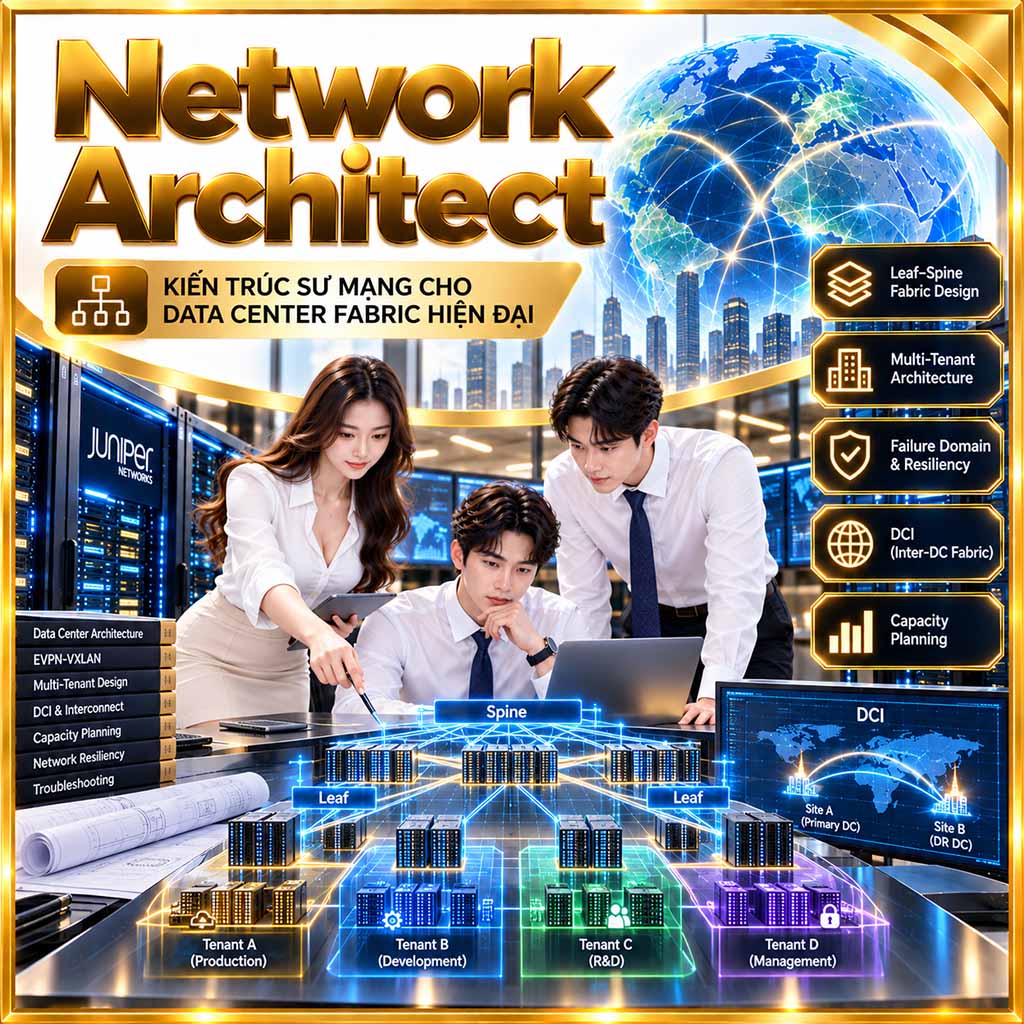
Kiến trúc sư mạng muốn nâng cao năng lực thiết kế và quy hoạch hạ tầng Data Center hiện đại, tập trung phát triển chuyên sâu về Leaf–Spine Fabric, Multi-Tenant Architecture, Failure Domain, Resiliency, DCI và Capacity Planning.

Solution Architect
Nhân sự kiến trúc giải pháp muốn nâng cao năng lực chuyển hóa yêu cầu kỹ thuật và kinh doanh thành kiến trúc khả thi, tập trung phát triển chuyên sâu về Data Center Architecture, HLD, LLD và phương án triển khai phù hợp.

Network Consultant
Chuyên gia tư vấn mạng muốn nâng cao năng lực đánh giá và định hướng hạ tầng Data Center hiện đại, tập trung phát triển chuyên sâu về đánh giá hiện trạng, phân tích yêu cầu, thiết kế kiến trúc, migration và chuẩn hóa Data Center Fabric.

Solution Engineer
Kỹ sư giải pháp muốn phát triển năng lực xây dựng các kiến trúc Data Center chuyên sâu, tập trung làm chủ EVPN-VXLAN, Border Leaf, Multihoming, DCI và Multi-Site Services trong các môi trường hạ tầng doanh nghiệp hiện đại.

Presales Engineer
Nhân sự Presales muốn nâng cao năng lực tư vấn và xây dựng giải pháp Data Center chuyên sâu, phát triển khả năng phân tích yêu cầu, xây dựng Solution Design, đề xuất kiến trúc và bảo vệ phương án kỹ thuật trước khách hàng.

Network Operations Engineer
Nhân sự vận hành mạng muốn nâng cao năng lực bảo đảm tính ổn định và độ tin cậy của Data Center Fabric, tập trung phát triển chuyên sâu về Monitoring, Validation, Failure Testing, Root Cause Analysis, Recovery và Operational.

Network Automation Engineer
Kỹ sư mạng muốn phát triển năng lực tự động hóa Data Center, tập trung ứng dụng Jinja, Junos PyEZ và Ansible vào Configuration, Backup, Validation, Compliance và Fabric Operations, đồng thời chuẩn hóa và tối ưu quy trình vận hành.

Technical / Infrastructure Lead
Nhân sự phụ trách kỹ thuật và hạ tầng muốn nâng cao năng lực quản trị kiến trúc Data Center, tập trung vào đánh giá kiến trúc, kiểm soát thiết kế, chuẩn hóa triển khai, nghiệm thu và định hướng vận hành Data Center Fabric.

System Engineer
Kỹ sư hệ thống muốn nâng cao hiểu biết về Data Center Networking, tập trung phát triển khả năng tích hợp Network Fabric với Server, Virtualization, Applications và Shared Services trong kiến trúc hạ tầng Data Center tổng thể.

Infrastructure Engineer
Kỹ sư hạ tầng muốn phát triển năng lực tích hợp và tối ưu kiến trúc Data Center tổng thể, tập trung kết nối hiệu quả giữa Network, Compute, Virtualization và Data Center Services trong môi trường hạ tầng doanh nghiệp hiện đại.

Đào tạo doanh nghiệp
Doanh nghiệp muốn chuẩn hóa và nâng cao năng lực đội ngũ Network, Data Center, Infrastructure, Operations và Architecture, với nội dung có thể tùy chỉnh theo kiến trúc hệ thống, yêu cầu triển khai, vận hành, tự động hóa và xử lý sự cố.
Nhằm giúp học viên và doanh nghiệp có cái nhìn đầy đủ trước khi đăng ký, Stratex Global tổng hợp 40 câu hỏi thường gặp quan trọng nhất về Juniper Core Data Center – JCDC-72. Bộ FAQ bao quát các nội dung cốt lõi từ mục tiêu chương trình, yêu cầu đầu vào, cấu trúc đào tạo, Fabric Lab, EVPN-VXLAN, Multihoming, DCI, Automation, Troubleshooting và Capstone đến đánh giá năng lực, chính sách học viên và đào tạo doanh nghiệp. Thông qua phần FAQ này, người học có thể nhanh chóng đánh giá mức độ phù hợp của chương trình, hiểu rõ phương pháp Advanced Core Data Center Engineering và hình dung cụ thể năng lực có thể đạt được sau khi hoàn thành JCDC-72.
Juniper Core Data Center – JCDC-72 là chương trình Level 4 – Advanced Core Data Center Engineering, tập trung phát triển năng lực thiết kế, triển khai, kiểm chứng, vận hành và xử lý sự cố trên kiến trúc Juniper Data Center IP Fabric hiện đại.
Chương trình không tập trung vào việc ghi nhớ câu lệnh. Học viên phải hiểu kiến trúc, triển khai hệ thống, kiểm chứng Control Plane/Data Plane, thực hiện Failure Testing, Troubleshooting, Recovery và bảo vệ quyết định kỹ thuật bằng bằng chứng.
Tổng thời lượng là 72 giờ đào tạo chuyên sâu – 24 buổi × 3 giờ.